Thursday, May 16, 2013

A dose of inflation would help the eurozone medicine go down

Everyone accepts that persistently high inflation can damage economic growth and arbitrarily punish some groups in society while benefiting others. But in Europe at least, the risks of excessively low inflation are often ignored. In the face of chronically weak demand, the eurozone now faces the prospect of deflation. This promises to depress economic growth further and make it yet harder to pay down debt. Indeed, the role of higher inflation in helping to address the eurozone crisis is poorly understood. If the single currency is to survive, it needs much higher inflation than at present, especially in Germany.

Policy-makers are right to warn of the risks of losing control over inflation. Persistently high and volatile inflation can make it hard for firms to calculate prices and future profits, deterring them from investing. It can create wage spirals and, crucially, redistribute income from savers to borrowers. But eurozone policy-makers are dangerously sanguine about the risks of low inflation. When inflation falls very low, consumers and firms tend to sit on cash rather than spend it, in the case of consumers because they expect prices to fall further or in the case of firms because they fear a further weakening of demand. This is what economists mean by a ‘liquidity trap’: households do not want to spend and firms do not want to invest, making a prolonged recession self-fulfilling. Meanwhile, very weak growth and low inflation make it much harder to pay down debt. The US and most of Europe spent much of the 1930s in such a liquidity trap, and after spending the last 20 years in one, Japan is now desperately trying to escape it. If the eurozone is not to get caught in such a vicious circle, it will need to rapidly stimulate its economy.

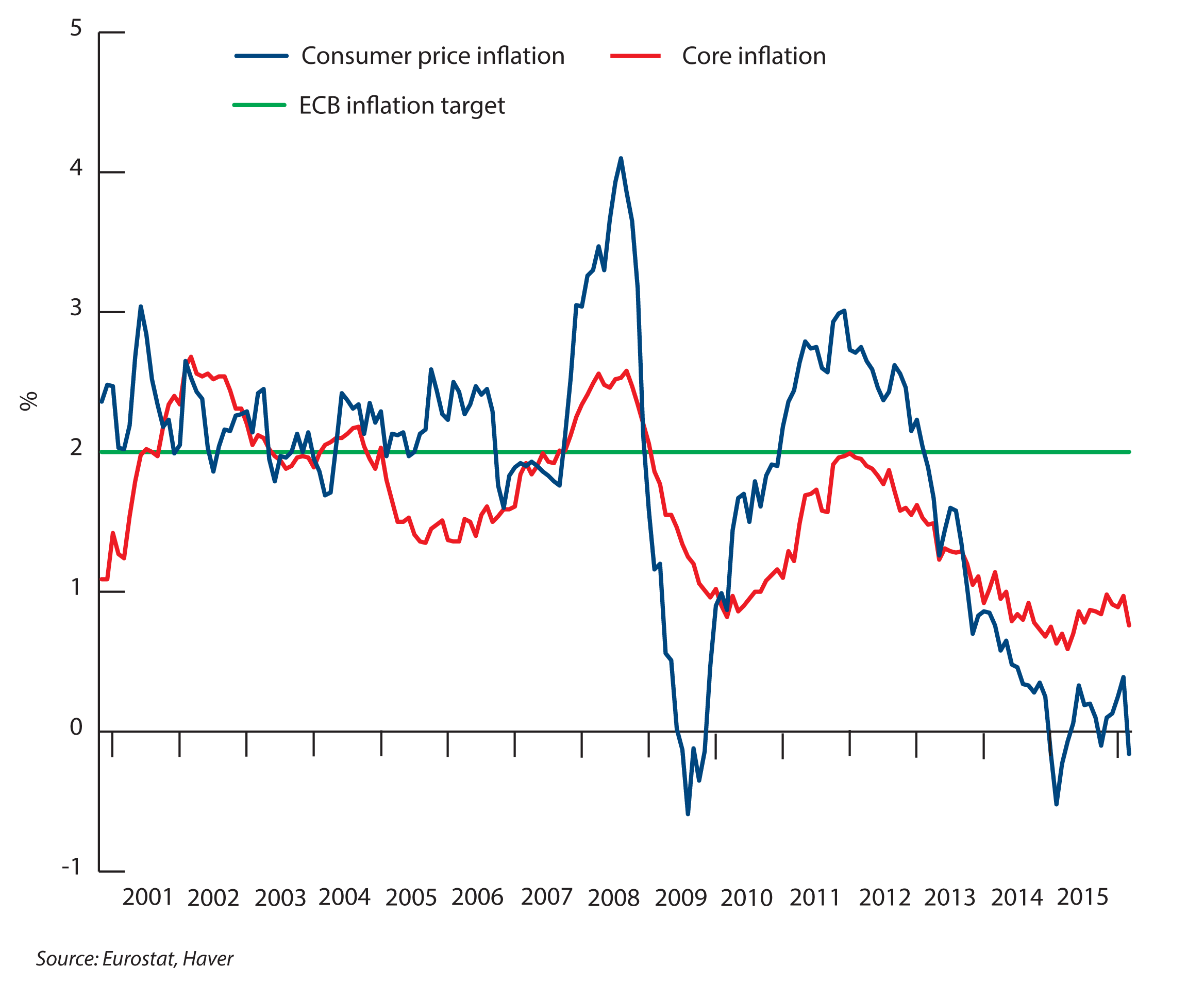
Headline eurozone inflation turned negative over the second half of 2009, before rebounding and averaging almost 3 per cent over the second half 2011, and hence well above the ECB’s target of ‘close to 2 per cent’. The apparent strength of inflation was used to rebut those who argued that the eurozone needed lower interest rates and more fiscal stimulus to counter the downturn. Such policies, it was argued, would lead to unacceptably high inflation. For example, the ECB persistently used above target inflation to justify its refusal to cut interest rates further or launch unorthodox forms of monetary stimulus such as quantitative easing (QE). This refers to the practice of central banks purchasing financial assets from commercial banks and other private institutions. But much of the inflation over this period reflected higher energy (and food prices) and crucially, increases in administered prices and value-added-tax (as governments have attempted to get on top of fiscal deficits). In reality, the headline rate of inflation says little about underlying inflation pressures. For example, at no point has inflation excluding energy and food exceeded 2 per cent. And stripping out the impact of tax rises and increases in administered prices, inflation has been below 2 per cent throughout.  

The argument for targeting headline (as opposed to core) inflation is that it is the headline rate which sets inflation expectations and wage settlements, and hence the future rate of inflation. But this has not been the case: the headline rate of eurozone inflation fell to 1.2 per cent in April 2013. Excluding energy and food, as well as rises in taxes and administered prices, it will have been just 0.4 per cent and hence perilously close to zero. In some countries this underlying measure of inflation is already well into negative territory. For example, in Spain prices are falling by between 0.5 per cent and 1 per cent. The headline rate of inflation will fall back rapidly, once the impact of tax rises and increases in administered prices fall out of the inflation indices. The reasons for the extreme weakness of underlying inflation are obvious. With economic activity so depressed, workers are having to accept whatever wage rises employers offer, while firms are having to cut prices because disposable income is falling.

Many eurozone policy-makers appear to welcome the fact that inflation is now so low in the struggling eurozone countries. After all, only by ensuring that their costs rise less slowly than Germany’s can they hope to rebuild their trade competitiveness.  But they also need some inflation in order to gradually erode the real value of their debts and ensure their debt burdens are sustainable. Were German inflation running at 3-4 per cent, the struggling eurozone economies might be able to reconcile these conflicting pressures. But German inflation stood at just 1.1 per cent in April, making the adjustment very difficult. 

The European Commission likes to laud the narrowing of current account deficits in the peripheral countries as evidence of the progress these countries are making in boosting their competitiveness.  But this is largely down to collapsing demand for imports, not wage restraint or structural reforms. For example, Spanish imports were 20 per cent lower in 2012 than in 2007, Italy’s fell 12 per cent over the same period. This, in turn reflects the weakness of domestic demand – down by 13 per cent and 9 per cent respectively over this period. Were domestic demand to recover in Spain and Italy, their current account deficits would quickly widen again. As the Commission’s own data illustrate, real exchange rates remain hugely out of kilter across the eurozone. The ‘German euro’ is strongly undervalued, whereas in Italy and Spain the reverse is the case. 

Normally, when faced with such pervasive economic weakness and mounting deflation pressures, central banks would be doing whatever it took to raise inflation expectations. Only in that way can they hope to bring about the negative real interest rates needed to persuade firms and business to invest: when real interest rates are negative, it is expensive to sit on cash. If interest rates were close to zero, this would mean unconventional measures aimed at loosening monetary policy, such as QE, and committing to run a very loose monetary stance for a prolonged period of time. 

The ECB reduced interest rates by 0.25 of a percentage point to 0.5 per cent at its May meeting, but there is little indication that it is planning an aggressive monetary relaxation. The ECB could also launch QE so long as it concentrated its asset purchases on the eurozone assets as a whole rather than on particular member-states. Crucially, it could attempt to boost inflation expectations by committing to keep interest rates at their current lows until 2015 (as the US Federal Reserve has done). At present, the impact of low eurozone interest rates on inflation expectations is limited by the fear that the ECB will tighten as soon as inflation starts to rise. If households and businesses are confident that policy will remain loose even once inflation has started to rise, it could make them readier to spend rather than sit on cash.

There are essentially two reasons why this is not happening. First, Europe’s policy-makers continue to deny that Europe is in a liquidity trap. They believe that eurozone economies are so weak because growth potential has fallen steeply, rather than because demand has fallen far short of supply. The solution therefore lies in structural reforms; monetary stimulus and a drive to raise inflation expectations would achieve little. There is no doubting that the rate of potential output growth across the eurozone has fallen as a result of structural problems. But there is also no doubt that output gaps (the difference between actual and potential output) remain huge, as acknowledged by the IMF, and are getting bigger as households are not spending and firms are not investing. 


Second, although the eurozone as a whole needs higher inflation, some countries are much more in need of it than others. The Bundesbank has acknowledged that higher German inflation could be necessary to facilitate adjustment, but concern that it could erode the real value of savings means that Germany continues to stand in the way of monetary stimulus. Although Jens Weidmann voted in favour of cutting interest rates at the ECB’s meeting earlier this month, he has warned that the eurozone must avoid negative interest rates. 


However, the choice for Germany is not between the status quo or higher inflation but between large debt defaults across the eurozone (and a possible dismantling of the eurozone) on the one hand or higher inflation on the other. The least painful of these would be higher inflation, even if it were unpopular with German savers. Default was manageable in Greece, but defaults by Italy and Spain would pose an incomparably sterner test for the eurozone. The collapse of the euro, even ignoring the political fall-out, would be very painful for Germany: the country’s real exchange rate would rise very strongly.

Faced with such unpalatable alternatives, the new German government (whatever its composition) will probably not stand in the way of the ECB loosening monetary policy further, perhaps by launching QE. But the Germans are almost certain to oppose any ECB commitment to maintain a loose stance until the recovery is underway and inflation is rising, as this would imply robust inflation in Germany. If so, the central bank could struggle to raise inflation expectations. And the eurozone will struggle to escape its liquidity trap.

Simon Tilford is chief economist at the Centre for European Reform.

Thursday, May 09, 2013

Commission should move to structural reform of the ETS


The EU regularly describes the ETS as the centrepiece of its climate policy. This centrepiece is currently a failure. Climate change is already killing hundreds of thousands of people each year, and costing the global economy hundreds of billions of dollars. Yet European efforts to strengthen the ETS are moving at a snail’s pace.

Last month the European Parliament rejected Commission proposals to postpone the auction of carbon allowances under the Emissions Trading System (ETS). The Commission had proposed this in an attempt to stop the carbon price falling even further, but Parliament’s rejection of such ‘backloading’ means that the carbon price is now down to about €3 per tonne. This is far too low to encourage firms to invest in low-carbon technologies.

In June 2012 I argued in a CER policy brief '
Saving emissions trading from irrelevance' that withdrawing allowances from the market - which could be done either temporarily, as the Commission proposed, or permanently - was necessary to prevent the ETS becoming irrelevant. I assumed that allowance withdrawal was the approach that had the best chance of being agreed quickly. Nearly a year later, allowance withdrawal has still not been agreed.  A second vote in Parliament is scheduled for early July. MEPs ought to pass the Commission proposal.

However, allowance withdrawal will not be enough to rescue the ETS. It needs to be combined with structural reform. I argued last year that the EU should also set an ETS price floor, to provide price stability and make the carbon price high enough to attract investment to low-carbon options. I concluded that the Commission should make these proposals as soon as possible.

In November 2012 the Commission did suggest structural reform. In its report ‘
The state of the European carbon market in 2012’ it wrote: “A carbon price floor would create more certainty about the minimum price, giving a better signal for investors.” But it went on to repeat long-standing objections to price intervention. Price-based mechanisms would “alter the very nature of the current EU ETS being a quantity-based market instrument. They require governance arrangements, including a process to decide on the level of the price floor”.

A price floor would indeed alter the nature of the ETS. It would turn the ETS from a quantity-based instrument into a price-based instrument. But it would also turn the ETS from an irrelevant instrument into an effective one. The Commission’s concerns about governance (with their implicit worries about political interference) are greatly overstated. Governance arrangements already exist to decide the quantity of allowances. Similar arrangements could be created to decide the price level.

On 7th May 2013 nine energy and environment ministers, from Germany, France, the Netherlands, Sweden, Denmark, Portugal, Finland, Slovenia and the UK, signed a statement urging the European Parliament to support the postponement of auctions and the Commission to “bring forward, by the end of the year at the latest, proposals to perform a proper structural reform of the EU ETS”.  This statement is welcome. But the Commission should not wait until the end of the year before making its structural reform proposals. The backloading proposal was only ever a small first step. The Commission should not be distracted by continuing exchanges  with Parliament on allowance withdrawal from the much more important task of proposing structural reforms.

Germany’s Peter Altmaier, environment minister, signed the statement. However, this does not mean that the German government is fully behind either backloading or ETS structural reform.  Different lines have been taken by the German economic and environmental  ministries. Chancellor Angela Merkel has spoken of the need for reform of the ETS, but is yet to take a clear position on what that reform should be. She probably will not do so before the federal elections in September.

The UK
House of Lords European Union Committee issued a report on 2nd May calling for an ETS price floor. The Committee argues that this “would simultaneously increase investor confidence and help to stabilise possible financing for infrastructure, low carbon innovation and related applications.” The UK government has introduced its own ETS floor price, which may attract low-carbon investment to the UK but will not help the global climate, because fewer allowances bought in the UK will lead to more allowances being available elsewhere. And the UK government has said in the past that it opposes a Europe-wide price floor because it vehemently opposes EU involvement in revenue raising.

This is not a sensible position for any government to take. EU measures are not imposed by ‘Brussels bureaucrats’ – despite what parts of the British media like to claim – but negotiated by European institutions, including national governments in the Council.
 
National governments’ desire for extra revenue may actually help the ETS reform process. A €30 carbon price, rather than the current €3, would increase tenfold the amount of revenue that governments receive from the auctioning of emissions allowances. Many European governments badly need extra revenue. Even the German government needs more money in order to pay for its Energiewende.

So the Commission should be ambitious and press ahead with structural reform proposals, including a price floor. The ETS was a creditable experiment. But the experiment has not worked. The ETS must be transformed or abolished. Otherwise it is just a fig leaf, hiding Europe’s tardiness on climate change.

Stephen Tindale is an associate fellow at the Centre for European Reform.  


Wednesday, May 01, 2013

NATO and the costs of star wars

Over the last decade, the US has spent tens of billions of dollars constructing a shield to stop nuclear missiles from North Korea or Iran reaching its soil. So far, the shield does not work. Fortunately for the Americans, neither Pyongyang nor Tehran has nuclear missiles that could hit the US. Unfortunately, however, America's missile defence programme has upset China and Russia, two countries that do have nuclear arsenals that could reach its homeland. America's European partners in NATO should try to convince Washington to scale back its missile defence ambitions for the next few years. Not only would this allow the US government to spend its shrinking defence budget on more pressing military needs. It would also improve European security by reducing tensions between NATO and Russia.

Since the collapse of the Soviet Union, the US has been increasingly worried about nuclear attacks by 'rogue' states. In 1998, a study group chaired by Donald Rumsfeld predicted that North Korea and Iran could field intercontinental ballistic missiles within five years. Today, however, Iran has neither intercontinental missiles nor a nuclear bomb. In March of this year, a report from the Pentagon's intelligence agency (erroneously declassified) assessed "with moderate confidence" that Pyongyang could build a nuclear device that fits on a missile. But there is still no evidence that North Korean missiles are sophisticated enough to reach the US.

Although the American mainland is not currently under threat, every president since George H.W. Bush has sought to deploy nation-wide defences against a limited attack by ballistic missiles. Reviving some of President Ronald Reagan's 'star wars' ambitions, the US has had missile interceptors deployed in Alaska and California since 2004. Both the George W Bush and Obama administrations have also had various plans to deploy interceptors against intercontinental missiles at bases in Europe. (The Obama administration, working with NATO, has also been deploying interceptors in Europe to protect Europeans and US troops in the region against shorter-range missiles from Iran – a threat which does exist.) In March, Secretary of Defence Chuck Hagel announced that because of technical problems and budgetary constraints, the US is suspending its efforts to build Europe-based strategic interceptors. He also said that in response to the bellicose attitude of North Korea's new leader, the US will add 14 missile interceptors in on its West Coast, and perhaps deploy a few more on the East Coast, too.

The Obama administration has been wise to cancel the European leg of its strategic missile defence plans. Several recent studies had highlighted significant shortcomings in the programme. For example, a 2012 report by the National Academy of Sciences concluded that the interceptors planned for Europe would have been too slow to stop an incoming missile. But the US would be ill advised to increase the number of interceptors on the West – and possibly East – Coast. Studies have shown that the interceptors in Alaska and California do not work well either. According to Congress' Government Accountability Office, ten out of the 30 interceptors rely on technology which has never intercepted a missile during tests. The GAO estimates that it will take several years to repair this technology, costing the US taxpayer an additional $700 million. Hagel has promised to fix these glitches before the new interceptors are deployed. But the Pentagon does not yet have a solution to another big problem. None of its interceptors can distinguish between an incoming warhead and debris or decoys. (Ballistic missiles can easily carry decoys in addition to warheads.)

America's strategic missile defence efforts have made the US taxpayer fund a weapon that does not work to tackle a threat that does not exist. They have also antagonised China and Russia. Both countries worry that US technological breakthroughs could undermine their strategic deterrents. Moscow has been most displeased. The Kremlin has been asking for legal guarantees that the US would not direct its missile defences against Russia's strategic nuclear weapons. To reassure Russia, the Obama administration has encouraged Moscow to co-operate with NATO's defence programme against Iranian short and long-range missiles. (Moscow is less worried about NATO's defences against Iranian short-range missiles because the interceptors used would be too slow to stop a Russian strategic missile.) Washington has also been willing to provide Moscow political guarantees that its nuclear deterrent is not under threat.

But so far, the Obama administration has refused to give Russia legal guarantees. The US has made such commitments in the past. The Anti-Ballistic Missile Treaty established limits on what Moscow and Washington could do in this area from the 1970s until 2002. President George W Bush then withdrew from the agreement in order to pursue America’s missile defence ambitions unhindered. The Obama administration fears that Republican senators – who are keen on missile defence – would not ratify a treaty that would constrain the US. As a result, missile defence has become one of the most contentious issues in a troubled US-Russia relationship. Moscow has refused to negotiate further cuts in its nuclear arsenal until the issue is resolved. Last year, the chief of the General Staff of the Russian armed forces threatened to attack the European NATO countries hosting US missile defences. And according to press reports, Russian bombers have been simulating strikes against American missile defence installations.

Now that Hagel has cancelled the European leg of US strategic missile defences, there is a chance that NATO and Russia could end their dispute. Senior American and Russian officials have resumed talks about Russia co-operating with NATO's missile defence efforts. US policy-makers have also been encouraging Moscow to negotiate new bilateral nuclear reductions – a top priority for President Barack Obama. According to some Russian officials, President Vladimir Putin may be open to an agreement when he meets President Obama at the G8 in June or at their bilateral summit in September. But the Russians still want legal guarantees on strategic missile defences. 


Europeans welcome the possibility of improved NATO-Russia ties. Most of them have never been convinced of the need for, or feasibility of, strategic missile defences and many disliked Washington's decision to leave the ABM treaty. Germany and others have been keen for Russia to co-operate with NATO's missile defence programme as a way to alleviate tensions. To maximise the chances of a deal between Washington and Moscow, Europeans should now encourage their American allies to include legal guarantees on missile defence in a new nuclear arms reduction treaty with Russia. Steven Pifer and Michael O'Hanlon from the Brookings Institution point out in their book 'The opportunity' that treaty limits could still allow the US to deploy all its planned defences against North Korea and Iran: the US and Russia could for example agree to each having a maximum of 125 interceptors capable of engaging intercontinental missiles. (The ABM treaty initially allowed for 200.) The treaty could also be limited to ten years, so that both sides could reconsider its ceilings in light of how the threats from North Korea and Iran evolve.

The White House, and Europeans, would struggle to convince some Republican senators to ratify such a treaty. But without it, Russia is unlikely to reduce its numerous tactical nuclear weapons – an arsenal that worries both Democrats and Republicans.  Europeans should also discourage their US counterparts from deploying additional interceptors against strategic missiles until tests have shown them to be effective. The risk of wasting large sums of money at a time of savage defence cuts should help senators to reassess their views on missile defence.

As Greg Thielmann, a former senior US state department intelligence official, remarks, Europeans have "tamed ill-considered American instincts" in the past: in the 1980s, Europeans encouraged a reluctant Reagan administration to negotiate the Intermediate-Range Nuclear Forces Treaty. For the benefit of NATO-Russia relations and global arms control, the Europeans should encourage their ally to reassess its stance again.

Clara Marina O'Donnell is a senior research fellow at the Centre for European Reform and a non-resident fellow at the Brookings Institution.

Thursday, April 25, 2013

European austerity: Turn or TINA?

Will European governments reverse the austerity course that has done so much to damage their already enfeebled economies? With the revelation of mathematical errors in the work of two Harvard economists, Carmen Reinhart and Ken Rogoff – who had claimed to show that economic growth falls off a cliff once a country’s ratio of debt to GDP reaches 90 per cent – another of the intellectual underpinnings for the current strategy has been swept away. As foreseen by the majority of mainstream economists, eurozone countries’ debt positions continue to worsen rapidly despite wrenching austerity and there is no sign of a rebound in consumer and business confidence. Mass unemployment and chronically weak business investment is waking people up to the folly of synchronised austerity in a depressed economy, hastening what President Barroso has termed (in an unguarded moment) the ‘political limits of austerity’. Everything argues for a change of course, but it could be slow in coming.

The assertion that fiscal austerity would actually boost economic growth – made by another pair of Harvard economists, Alberto Alesina and Silvia Ardagna – was always highly questionable, as was the Reinhart and Rogoff thesis. But the European Commission and European governments (including the British one) latched onto the work of Alesina and Reinhart and Rogoff to provide intellectual support for austerity. Even as the body of evidence against Alesina’s research accumulated, European policy-makers were slow to reject it. When they eventually did, they continued to argue that it was still necessary to pursue fiscal austerity so as to prevent ratios of debt to GDP exceeding the magical level of 90 per cent of GDP, despite the fact that austerity was depressing growth and increasing countries’ debt ratios. The question marks over the soundness of Reinhart’s and Rogoff’s work on debt levels and economic growth are certainly embarrassing for European governments and the Commission, but it is unlikely to dispel the myths around austerity. 

On the face of it, things do seem to be changing. The Commission has given eurozone countries a bit more time to meet their fiscal targets. In particular, it is dealing cautiously with France, which has resisted cutting its deficit as quickly as demanded. The Commission is being careful to place as much stress on the need for structural reforms as austerity. But all this amounts to less than it seems. The decision to give countries a bit more time is simply an acknowledgement that deficits are higher than they were supposed to be because economies are weaker than the Commission expected them to be. It does not represent a significant change of strategy. The fiscal position across the eurozone remains contractionary despite the region’s economy being stuck in a depression. For their part, the Germans are actually tightening policy despite the country’s budget being in surplus and the German economy having stalled. There is still no acceptance that running a budget deficit in a recession is a perfectly sensible economic strategy or that structural reforms will only pay off economically in the long-term, and only then if accompanied by a recovery of business investment.

Why is a policy U-turn unlikely, at least for the time-being? Many policy-makers probably did (and some probably still do) believe that the current austerity strategy is the correct one. Politicians in a number of core eurozone countries like to say, ‘We did our homework, it’s time for others to do theirs.’ Theirs was always a very partial reading of the causes of the crisis, but it has obvious appeal to national vanity and has become central to the narrative of the crisis in these member-states. Many policy-makers never believed in austerity as a solution to the crisis, but went along with it because it was the only politically possible course. They acknowledged that it made little sense to institutionalise pro-cyclical fiscal policy in the form of the fiscal compact, but understood that it was necessary in order to keep the Germans and other core members on board and ensure they acquiesced in a more activist approach by the ECB. This latter policy has ensured that French borrowing costs have come down steadily despite frustration at the slow pace of fiscal consolidation under Hollande’s government. 

However, the eurozone needs a big change of direction, not just a bit more time for countries to meet their fiscal targets. The possibility of this happening depends to a large extent on Germany. How could they be brought around? One way would be for the French, Italians and Spanish to unite in an attempt to face down the German government. It is quite possible that it will eventually to come to this, but it would be a risky strategy to play in the run-up to a German general election. Such a manoeuvre could easily backfire and would certainly be seen as an aggressive move by many Germans. Another way would be to redouble efforts to persuade Germany of the risks that austerity poses to itself. After all, the German economy is slowing quickly under the combined impact of falling exports to the eurozone and a slowdown in exports to China. This is exposing the underlying weakness of the country’s economy: stagnant domestic demand. But the politics are formidably difficult. The Germans might modify their narrative and agree to take some steps to strengthen domestic demand in Germany. But they are unlikely to accept that austerity is self-defeating, not least because this would leave them having to acknowledge the need for far-reaching institutional reforms of the eurozone.

For example, if struggling member-states face high borrowing costs because investors treat them as if they are borrowing in a foreign currency (rather than because their economic policies lack credibility), this strengthens the arguments in favour of allowing the ECB to act as a fully-fledged lender of last resort, or in favour of a degree of risk mutualisation. The ECB’s promise to stand behind the debts of eurozone countries (its so-called Outright Monetary Transactions) has proved remarkably effective so far. But ultimately the central bank will have to put money on the line, which it cannot do at present unless countries promise to abide by strict conditionality. The evidence of the last five years strongly suggests that attempting to meet these conditions would prove very damaging economically and politically. 

But the German and other core eurozone governments understandably want to avoid having to try to sell such reforms to their sceptical electorates, for fear of turning their voters against the single currency. This is why it will continue to suit many policy-makers to argue that the crisis is all down to rule-breaking, and the responsibility of individual member-states. Despite the overwhelming weight of evidence, both empirical and theoretical, many politicians will continue to trot out Margaret Thatcher’s favourite line: there is no alternative – TINA.

Simon Tilford is chief economist at the Centre for European Reform.

Friday, April 19, 2013

Is the euro crisis responsible for populism?


Populists and extremists are on the rise across Europe. Even Germany is now seeing the rise of a eurosceptic party. The euro crisis is the reason for growing political risk in the eurozone. Or is it? True, populist parties are more important in several euro countries. But the reasons for this are manifold and it is hard to detect a Europe-wide trend. An end to the euro crisis would not guarantee a return to predictable two-camp politics.

What is populism? At the most basic level, a populist is someone who advocates measures that you do not like. For the right-wing press, populists are the people who call for higher taxes, more welfare and the protection of industries. For the left-wing media, it is people who oppose immigration, diversity and the EU.

What populists tend to have in common is that they contrast themselves with the political elites. "Populism is as much about style as it is about substance", says Tim Bale, politics professor at Queen Mary University in London and an expert on the subject. Populists usually claim that they alone represent the people while established political parties are portrayed as self-serving, aloof and corrupt. Populists dislike representative democracy and love referendums.

Applying this definition, the rise in populism in Europe predates the euro crisis by quite a few years. Think of Jörg Haider in Austria, Pim Fortuyn in the Netherlands, the Kaczynski brothers in Poland or Jean-Marie Le Pen in France.

Two trends have eroded people’s trust in public authority and thus helped the populists. First, globalisation, immigration and technological change are making life more complex. Centre-left parties can no longer credibly promise jobs and social security. The centre-right’s notions of stable families and individual responsibility sound barely credible. As old ideological divisions blur, mainstream parties on both sides promise to do 'whatever works'. Confused voters find the populists' clear, simplistic messages appealing.

Second, the spread of the internet and new media can help political upstarts to mobilise the masses. Many people nowadays trust the internet more than the mainstream media. And in their attempt to regain ratings, even serious broadcasters give colourful populists more air time than 'boring' centrists.

The euro crisis has not caused European populism but it is certainly fuelling it. In these vexing times, the simple solutions peddled by the populists are gaining traction in many eurozone countries. But each country has its idiosyncrasies.

Voters in some of the northern creditor countries got restive first. The eurosceptic and anti-immigration Freedom Party almost tripled its share in the Dutch election in 2010. One year later, the anti-bailout True Finns became the third largest party in the Finnish parliament. However, both parties seemed to have peaked already. In 2012, the Freedom Party's vote collapsed in the Dutch general elections, as did support for the True Finns in local elections.

Is it Germany's turn now? With the Alternative für Deutschland (AfD), a eurosceptic party will for the first time contest a general election in Germany in September. The AfD's main objective is for Germany to leave the euro, although the party supports other aspects of European integration. One opinion poll showed that almost a quarter of Germans would "in principle" consider voting for a eurosceptic party; but in another poll, only 3 per cent said they would choose AfD if elections took place now. The AfD’s leader, Bernd Lucke, a soft-spoken boyish-looking academic, is an odd sort of populist, although, like most of his European peers, he promises more direct democracy and an end to the politics of yore. However, since most of the party’s upper echelon consists of bespectacled professors and well-to-do businessmen, it appeals to middle-class centrist voters – who are overwhelmingly still happy with Angela Merkel and her euro policies.

In Germany, as in other North European countries, the main impact of the populists is that they throw well-rehearsed coalition politics into disarray. The AfD might not get the 5 per cent needed for parliamentary seats. But it might steal just enough votes from the (already suffering) Liberals to deprive Merkel of her natural coalition partner after September. Populists also have impact because mainstream politicians often feel compelled to usurp their ideas. Such tactics hardly ever work, partly because the populists can easily move to further extremes and partly because moderate voters (still a majority in all North European countries) resent politicians chasing the populist vote.

If populism in Northern Europe is destabilising but not disastrous, what about the south? In Greece and Italy, the populists are no longer fringe figures. In the Greek elections of May 2012, the hard-left Syriza party came first after promising Greeks an end to EU-imposed austerity; the neo-fascist Golden Dawn got 7 per cent, with a similar share going to another right-wing nationalist party (a re-run of the vote a month later lifted the centre-right New Democracy just above Syriza but otherwise changed little). In Italy’s election in February 2013, the anti-EU Five Star Movement of Beppe Grillo gained 25 per cent, a bigger slice than any other single party.

With unemployment now standing at 27 per cent in Greece, and Italy suffering its longest recession in two decades, how could people not have voted for populists? They could have. Spain also has 27 per cent unemployment and not a populist in sight. The Irish and Portuguese people have suffered tremendously in the euro crisis but they have not deserted the established parties.

Greece and Italy stand out because their political systems had become dysfunctional long before the economic crisis. Corruption and nepotism exist in most European countries – but not to the extent that used to prevail in Rome and Athens. It is therefore understandable that Greeks and Italians now refuse to back established parties that have done little for their respective countries in decades.

The deepest rift in Greek politics runs not between supporters and opponents of austerity but between those who have long benefited from a bloated public sector (protected by, and closely intertwined with, New Democracy and the other mainstream party, Pasok) and those in the private sector who have borne the brunt of austerity.  To them Syriza’s promises of free health care and school meals, generous social welfare and higher minimum wages look appealing. But many of them simply cannot stomach supporting the two traditional parties of power anymore.

Greece is also one of the few places where the crisis has boosted the extreme right. One reason is growing resentment of the million-odd immigrants who arrived during the good years. Another is the breakdown of law and order that has accompanied the Greek economic collapse. The state is in such disarray that many Greeks now welcome Golden Dawn’s black-shirted hoodlums bringing some ‘order’ to their neighbourhoods – even if that entails hundreds of immigrants ending up in hospital after brutal beatings.

In Italy, the right-wing Lega Nord got a measly 4 per cent in the 2013 election. It had become tainted by too many years in government. Italians rejected all established political parties in the last vote, irrespective of whether they were pro or anti-austerity. They did not vote for their erstwhile technocratic prime minister, Mario Monti, either. Monti's tax hikes and budget cuts did not win him many friends. But his approval ratings (once at a stellar 70 per cent) only collapsed once he stopped being a technocrat and entered the political fray as an election candidate.

The tragedy in Greece and Italy is that this much-overdue re-ordering and renewal of the political system comes at a time when both countries desperately need strong and stable governments. It might be years before that is a realistic prospect. Populists do have a habit of running out of steam. The closer they get to power, the more they come under pressure to present credible solutions and make compromises. At this point, they either become mainstream or they deflate. Until this happens, populism and political uncertainty will continue to make the euro crisis more combustible.

However, it is not certain that an end to austerity would make Greek and Italian politics predictable, nor that without further bailouts there would be no populism in Northern Europe. In an age where voters are both confused and easily malleable via the internet and social media, politics will not return to the staid two or three party systems of the post-war years. 

Katinka Barysch is deputy director of the Centre for European Reform.

Friday, April 12, 2013

Out of range, out of mind: Is there a role for Europe in the Korean crisis?

From London or Brussels, the situation on the Korean Peninsula can appear – in the words of former British Prime Minister Neville Chamberlain – a "quarrel in a far-away country between people of whom we know nothing". On one side, a mad dictator (you only have to look at his hairstyle) with nuclear weapons and long-range missiles of doubtful reliability; on the other side, the country of Gangnam Style and Samsung. The nuclear weapons cannot reach Europe. And the big global powers, the US and China, are already engaged. Europe could leave them to sort things out, at best playing the role of Greek chorus in support of US policy (as a Western ex-official described it recently).

But that would be a mistake. Seasoned Korea watchers say that the current crisis is as serious as they can recall. Against that background, as the US flies B2 bombers over South Korea and Japan deploys ships with anti-missile defences, one could ask, as Stalin did of the Pope, how many divisions the EU has. But while it may not have armies there, Europe has interests and assets in the region. It should think about how to protect the former and use the latter.

Any conflict would have a significant global economic impact. The Republic of Korea is the world's 15th largest economy and Europe's 9th largest trading partner. And if North Korea started lobbing missiles at Japan (the EU’s 7th largest trading partner), or if China, the EU's second largest trading partner, became directly involved in the fighting – admittedly, highly unlikely – that would multiply the effects on Europe’s own economic well-being.

Europeans also have an interest in the global order which the Democratic People's Republic of Korea (DPRK) threatens: the nuclear non-proliferation regime; norms on refraining from the threat or use of force in international relations; and respect for UN Security Council resolutions. The failure of global powers and institutions to stop North Korea becoming a de facto nuclear weapons state is already a bad precedent.

Finally, the crisis could have repercussions for transatlantic relations. Though there are American officials who think that greater European involvement in Asia would just complicate matters, there have also been calls from parts of the administration, including then-Defense Secretary Leon Panetta in January 2013, for increased European engagement there. If Europeans ignore these calls entirely, they risk strengthening the perception within Washington that the value of the transatlantic alliance is dwindling.

What more can Europe do? There are clear constraints; a diplomatic initiative cutting across the longstanding Six Party Talks process, for example, or any move to soften sanctions on North Korea without significant movement from Pyongyang, would be very unhelpful. But in the short term Europe can work for de-escalation. We do not know exactly what Pyongyang wants, but we can assume that the North Korean authorities are looking for concessions from the international community: aid, or a peace treaty with the US, for example. They need to hear a consistent message that this is the wrong way to set about things. The Europeans should signal strongly to Pyongyang that its aggressive stance will get it nowhere. Statements this week by Baroness Ashton, the EU High Representative, who called on North Korea to re-engage constructively with the international community, and by Anders Fogh Rasmussen, the NATO secretary general, whose message was "Stop what you are saying, stop what you are doing", are a good start. The EU has already imposed wide-ranging sanctions on North Korea following its December 2012 ballistic missile launch and its February 2013 nuclear test. It should tell Pyongyang clearly that while it would rather reward genuine efforts to reduce tension, it will not hesitate (for example) to restrict the country’s access to foreign currency in response to further provocative acts. 

Europeans should also intensify contacts with China and Russia – which cannot be suspected by North Korea of speaking on behalf of the US – and urge them to keep up their recent efforts to discourage North Korea's aggressive posturing. President Xi Jinping’s remarks at the Boao Forum this month, in which he said "no one should be allowed to throw a region and even the whole world into chaos for selfish gains", were evidently aimed at North Korea. China also seems to be making quiet moves to tighten implementation of the UN Security Council's financial and trade sanctions against North Korea. The EU should let the Chinese know that it welcomes such steps. 

If this becomes a shooting war, Europe's practical role in Korea will be limited (though European forces may be called on to stand in for US forces in areas closer to home, and some allies may have niche capabilities to offer). But if, as most experts believe, the situation eventually calms down, in the longer term Europeans can help North Korea and the concerned powers to move forward by taking the initiative in four areas.


First, the EU should reinstate its formal political dialogue with the DPRK, postponed last November as tension around North Korea’s weapons programmes grew. The Union should also encourage the European Parliament to keep channels of communication open. The Parliament wants to maintain a firm line with North Korea but it has in the past had contacts with the DPRK's Supreme People's Assembly. Even if EU officials and MEPs are unlikely to get close to any of the real decision-makers in North Korea, such contacts would expose North Korean officials to European thinking and perhaps challenge their preconceptions about Western aims.

Second, the EU should support 'track-two' dialogues. Think-tanks and academic institutions in several European countries have acted as venues for discreet discussions between North Korean and Western experts and former officials. If the North wants to improve relations – an important caveat – then such fora could allow it to explore new approaches without commitment and without having to take public positions. A degree of official backing from European governments or the EU itself could help to convince the North Koreans that Europeans are also serious about helping to reduce regional tension and improve relations.

Third, the EU could strengthen people-to-people and cultural co-operation. The North Korean authorities do not make this easy, as the 2009 closure of the Goethe Institute reading room in Pyongyang showed. But there have been some successes, such as the visit of the Munich Chamber Orchestra in 2012 and the showing of 'Bend it like Beckham' on state television in 2010; and the British Council has a long-running programme of teaching English teachers in North Korea, using a UK-focused curriculum. Without exaggerating their impact, such connections could help to expose some North Koreans to the reality of life outside, and implicitly encourage them to draw a contrast with official propaganda about the West.

Finally, Europeans should support economic and business training. In the long run, nothing in North Korea can improve much without a radical change of economic course. Where is the DPRK going to find the people to lead and manage such a process? Inevitably, China will have the greatest part to play, given its proximity and its own history of economic transformation. But Europeans – and especially, perhaps, those from the former communist countries – should  offer their insights and expertise. According to Professor Susan Shirk of the University of California at San Diego, and a former senior State Department official, such low-key, non-political capacity building could strengthen the voices of economic rationality within the country.

What tools does Europe have? Europeans have political ties with all the players in the region. The EU has had a 'strategic partnership' with South Korea since 2010, and there are regular high-level contacts between Brussels and Seoul. The High Representative discussed the situation in the region with South Korean foreign minister Yun Byung-Se on April 8th. The EU has a wide-ranging political dialogue with Japan, from summit level downwards. 

The Union also has a formal high-level dialogue with China on strategic and foreign policy issues. China is probably the only country with any significant degree of influence over North Korea. Beijing has hitherto prioritised stability in North Korea over everything else, worried by what might happen on the border if internal change led to disorder. The EU has stepped up its contacts with Beijing on North Korea, expressing appreciation for the recent steps the Chinese have taken (for example in co-sponsoring the latest package of UN Security Council sanctions after North Korea's third nuclear test in February) and encouraging them to be firm with North Korea.

While the US, Japan and South Korea have no diplomatic relations with the DPRK, seven EU member-states – Bulgaria, the Czech Republic, Germany, Poland, Romania, Sweden and the UK, though not the EEAS – have embassies in Pyongyang, which provide a source of first-hand information and a channel for communication. The Swedish Embassy also represents US diplomatic interests in Pyongyang. There are occasional bilateral visits to Pyongyang from Europe, for example by a Dutch agricultural trade mission in 2012. The EU has a small programme of humanitarian assistance, focused on vulnerable groups in North Korea. Europeans have a history of quietly facilitating dialogue between North Korea and the outside world, including through business education.

The Korean Peninsula is far away, but we should not make the mistake of equating distance with lack of importance to Europe. Good or bad, what happens there will affect us. Even if their clout is relatively limited, Europeans should think creatively about how to nudge developments in the right direction.

Ian Bond is director of foreign policy at the Centre for European Reform.

Wednesday, April 03, 2013

The EU's Rubik's cube: Who will lead after 2014?

Next year, EU leaders will decide who will succeed Herman Van Rompuy, José Manuel Barroso and Catherine Ashton as, respectively, the next president of the European Council, president of the European Commission and high representative for foreign affairs. These (no doubt) excruciating deliberations will begin in earnest after the European Parliament (EP) elections in May 2014.

EU watchers remember well the surprise – and for some, disappointment – that greeted the announcement of Van Rompuy and Ashton in late November 2009. Both appointments were judged to indicate a low level of ambition on the part of national governments for the EU leadership posts created by the Lisbon treaty. Likewise, the earlier reappointment of the conservative and careful Barroso for another five years was an homage to the status quo.

What do the choices of 2009 bode for those ahead? Back then, EU governments wished to avoid a trio of hyper-assertive egos at the EU's helm. But their bigger concern was to match a tiny pool of credible candidates with the expectation that the new appointments would reflect as broad a cross-section of the Union's membership as possible.

The Lisbon treaty’s requirements made this task even harder: the European Parliament – along with a majority of EU countries – must now approve the president of the Commission and the high representative for foreign policy (who is also a member of the college of European commissioners). Since the Parliament’s own presidency traditionally alternates between its left and right political groupings, the EP's negotiators insisted that one of the EU’s top three should be a socialist. That opened the way for appointment of Baroness Ashton (from the British Labour Party) as high representative. This choice probably also sets a precedent that at least one of the three positions should be held by a woman.

In addition, the Lisbon treaty says that governments should nominate a new Commission president while “taking account of the European elections” and that the EP will henceforth “elect” as opposed to simply approve the post. Hence the EP's political groupings are planning to present their own candidates for Commission president in 2014. For example, Martin Schulz, EP president since 2012, wants to be the nominee of the pan-European socialists; Viviane Reding, the EU's justice commissioner, clearly wants to run for the conservatives, known as the European People's Party (EPP); as does Guy Verhofstadt for the liberals. (If the latter two are unsuccessful in securing nominations, they may end up sharing the post of EP president as a consolation prize.) The EPP is usually the largest political party and therefore its candidate can expect to become Commission president, perhaps with some support needed from the liberals. 

The idea is to boost the democratic legitimacy of the Commission, which has gained new powers to screen national budgets as a result of Europe's debt crisis. But it is currently an open question as to whether each of the EPP, the Party of European Socialists (PES) and the Alliance of European Liberals will be able to agree upon and then unite behind a credible candidate. Furthermore, much of Europe is mired in recession, with high unemployment and poor economic prospects. Eurosceptic movements have been growing in several countries in reaction to the eurozone crisis, which means that the European election is wide open to political reverses, populists and protest votes. All of this makes the elections a potentially volatile element in the appointments process.

A second key factor will be the impact of the incumbents. Although unwisely dismissed as a ‘non-entity’ by some critics, Herman Van Rompuy has enjoyed success as the first permanent president of the European Council, even though the job entails few resources or formal powers. The former Belgian prime minister’s consensus-building skills have been important in managing the worst phases of the eurozone crisis so far, and have helped EU leaders to agree a deal on the Union’s long-term budget in February 2013. Van Rompuy’s low-key successes make it more likely that his successor will have a similar profile: the former leader of a small-to-medium sized country who is quietly tough and a proven conciliator.

Ashton has fared relatively less well. Despite some real successes – such as brokering peace between Serbia and Kosovo, and keeping the British, French, Germans, Americans, Chinese and Russians together during the Iranian nuclear diplomacy – she has attracted many brickbats. Some of this can be attributed to her lack of foreign policy experience. But a more significant reason is the mismatch between governments’ expectations that the high representative could immediately deliver confident diplomatic responses to crises in Haiti, Libya and the Arab Spring while simultaneously creating a new European External Action Service (EEAS) from scratch. Ashton herself has likened this to flying a plane while building the wings.

Moreover, while national foreign ministries tend to complain about the failures of the EU's fledgling diplomatic corps, they would be equally likely to lament a highly activist high representative. (Britain has fought a long campaign to prevent EEAS officials speaking on behalf of the EU, in an attempt to thwart ‘competence creep'.) Several countries, including France and Germany, have circulated ideas on how to make the EEAS a more effective diplomatic player in the years ahead, notably by reducing the Commission’s stranglehold over it. If such brainstormings are to lead to tangible results, governments will need to seek out an already established foreign policy ‘star’ to be the next high representative.

Third, Europe's political landscape has changed significantly since 2009. Germany has emerged as the dominant EU country while France's own economic woes have for the present reduced its power over the Union. However, Berlin remains circumspect in the area of security policy, refusing, for example, to involve itself in the Libyan conflict in 2011, while being reluctant to support the French intervention in Mali this year against jihadist rebels.

The Mediterranean countries have haemorrhaged political influence, as their economies have fallen into crisis. Cyprus, Greece, Italy, Portugal and Spain – have either become clients or wards of the EU since 2009. Under David Cameron, Britain has exiled itself to the Union’s margins to such an extent that it is impossible to imagine a Briton in any senior EU portfolio after 2014 other than single market, competition or trade commissioner. And Poland now styles itself as the 'France of the East’: a country with a healthy and large economy,  a complement to, and restraint on, German power; and the independent, utilitarian leader of the newer member-states.

Given all these factors, who are the likeliest candidates for the EU top three in 2014? Of the Mediterranean countries, none seem to have a potential claim on a top EU post. Mario Draghi already heads the European Central Bank. And Franco Frattini – a former Italian foreign minister and European commissioner – is currently angling to succeed Anders Fogh Rasmussen as NATO secretary general in 2014. (Frattini faces competition from Belgium's Pieter De Crem, Norway's Espen Bath Eide, Slovenia's Danilo Türk, Slovakia's Miroslav Lajcak and perhaps even Turkey's president, Abdullah Gül, for the NATO post.)

Rasmussen would probably make a good high representative, especially as the former Danish prime minister could draw on his NATO experience to help develop the EU’s weak security and military structures. But the current Danish government, headed by former MEP Helle Thorning-Schmidt, is a coalition of socialist parties which would not nominate Rasmussen, a liberal. Thorning-Schmidt is currently so unpopular as prime minster that she herself is rumoured to be interested in the role of EU commissioner.

Nonetheless, Rasmussen should still be counted as a possible Council president since his candidature could be considered without an initial nomination from the Danes. Serving as the EU's rotating chairman during Denmark's 2002 EU presidency, Rasmussen successfully concluded tough negotiations over the terms of admission of eight new EU member-states, experience which should count strongly in his favour. This assumes that the post can be held by someone from a non-euro area country, however.

Poland’s current prime minister, Donald Tusk, and its eloquent foreign minister, Radek Sikorski, are clear favourites for the post of Commission president and high representative respectively, though of course both jobs could not go to Poles. Germany might back Tusk in order to cement Berlin’s political alliance with Warsaw and because it is time for someone from one of the newer member-states to get a top job. But would Tusk be strong enough to lead the Commission in difficult times, or even willing to seek the EPP's nomination for president? If not, his name should be included in the rather small pool of potential candidates to succeed Van Rompuy.

Another variable is whether Sikorski may replace Ban-Ki Moon as secretary general of the United Nations since, under the UN practice of Buggins’ turn, the next incumbent looks likely to be an Eastern European. Even if not, the UK is thought to be opposed to the outspoken and ambitious Sikorski becoming high representative: despite his British roots he has become a champion of European integration. Other potential candidates include Sweden’s Carl Bildt, Finland’s Alexander Stubb or Bulgaria's Kristalina Georgieva. The latter has impressed many as the EU's humanitarian aid commissioner.

Alternatively, Europe’s leaders may decide that – given current political realities – it would be prudent to fill one of the top EU posts with a German. Frank-Walter Steinmeier, the Bundestag opposition leader, and a former foreign minister, might secure the high representative post, for example. Even if his Social Democratic Party is not in government after September, Steinmeier has significant bi-partisan appeal and was vice-chancellor in Germany’s 2005-2009 grand coalition. Furthermore, his appointment would signal a new German interest in taking on more leadership responsibility in foreign policy.

France’s present weakness is one of the most worrying political developments in today’s EU, since this has led to French insecurity, German over-confidence and a rapid deterioration of the Franco-German relationship. Ideally, François Hollande, the French president, would promote Christine Lagarde, the current head of the International Monetary Fund for Commission president. Lagarde would represent the best chance of an effective counter-balance to the North European conviction that austerity alone is the cure for the eurozone's ills.

Under Lagarde, the IMF has been the most influential international critic of EU policies guided by this orthodoxy. However, Lagarde is a centre-right politician and former finance minister under Nicolas Sarkozy, and therefore would not secure the PES ticket. She is also currently mired in an as-yet inconclusive investigation by French police into allegations of corruption during her time in government. All of this probably renders Lagarde’s candidature invalid, which is a pity: she would make a stronger EPP candidate for Commission president than either Tusk or Reding.

However, Pascal Lamy – the current head of the World Trade Organisation and ex-European commissioner – has a respectable pedigree on the left, having served as an advisor to former French finance minister and Commission president, Jacques Delors as well as a former socialist prime minister, Pierre Mauroy. Hollande should consider promoting Lamy for the PES candidacy to help shore up French influence within the Union. 

Europe's leaders have a veritable Rubik’s cube of political considerations to solve in 2014 in order to appoint a new EU leadership triumvirate. They must find three candidates who together represent the right balance geographically and politically, as well as satisfying new sensitivities over democratic legitimacy, gender and the concern that the Union is slowly splitting into a eurozone cabal and an outer ring of non-euro rule-takers. The trio's final identity is largely contingent on the eurozone crisis, which will continue to re-shape European politics in the run up to the May 2014 elections.

Given Europe's current challenges, it is to be hoped that governments and the pan-European political parties co-operate together to agree a pantheon of star candidates. But what may happen is that the election results, combined with the alchemical effect of the appointments process itself, will eliminate early front-runners and give previously unlikely nominees a new veneer of credibility. In that sense, 2014 could well be a re-run of 2009.

Hugo Brady is a senior research fellow at the Centre for European Reform.

Thursday, March 28, 2013

Germany’s plans for treaty change – and what they mean for Britain


Last year, German leaders talked of the need to strengthen the eurozone through changing the EU’s treaties. One person who listened carefully was David Cameron. The British prime minister may have assumed that what Germany wants in the EU these days, it gets. When he made a big speech on Europe in January, Cameron predicted that the EU would need a new treaty in the next few years. He implied that Britain would be able to extract concessions from its partners, in return for signing the treaty – all in time for the referendum on UK membership that he promised in 2017.

But Cameron’s strategy is based on a false premise. The mood has changed in Berlin. Recent meetings there with government officials and politicians have convinced me that Germany will not push for the kind of treaty that Cameron wants, at least not in time for his 2017 deadline.

The Germans, it is true, are keener on treaty change than most of their European partners. When they encounter a problem, they look to contracts, laws and treaties, rather than to political fixes. And they may have a preference for treaty change rather than mere legislation, since politicians can easily change the latter. German officials also worry about the constitutional court in Karlsruhe, which has expressed concern about some steps taken by the EU to manage the eurozone crisis. The court could block further moves unless they are backed by new treaty articles.

In Berlin people talk about two sorts of treaty change – big and little. Proponents of a big new treaty want it to establish a ‘political union’. The first step would be a ‘convention on the future of Europe’, including MEPs and national parliamentarians, of the sort that met in 2001-03, before the drafting of the constitutional treaty. The second step would be an inter-governmental conference to draw up a treaty introducing changes like more power for the European Parliament, direct elections for the Commission president and tighter co-ordination of economic policy. Guido Westerwelle, the foreign minister, and Wolfgang Schäuble, the finance minister, have at various times supported big treaty change. Some Bundestag members and Foreign Ministry officials share their federalist sentiments.

But Chancellor Angela Merkel is in overall charge of EU policy. And she told a conference of the Trilateral Commission in Berlin on March 15th that Europe does not need a major new treaty in order to become competitive. She and much of her government have cooled on the idea of big treaty change for four reasons.

First, the government thinks – notwithstanding the imbroglio in Cyprus – that the eurozone crisis is more or less under control. The risk of the currency union breaking up has receded, and with it the need for dramatic moves towards greater integration. Second, the Germans understand Cameron’s tactic of using treaty change as a tool for extracting concessions from Britain’s partners, and they have no desire to give him that leverage.

Third, France and most other member-states do not want a big new treaty. They worry about the difficulties of ratification: some, such as Ireland and perhaps France, would have to hold referendums. The Germans have listened. As one German official commented: “If we embark on another major EU treaty, it could take us about ten years to get the whole thing negotiated and ratified, just like it did with the Lisbon treaty.”

Fourth, the more that some Germans have thought about political union, the more wary they have become. French officials often make the point that the Germans can easily enthuse about political union because they have never had to define precisely what it means. But if EU leaders sat down to draft a text for political union, the Germans would have to acknowledge that greater economic and political integration would cost them money, whether through a eurozone budget, eurobonds or some other mechanism for helping poorer countries.

Even if Germany’s general election in September produces a new coalition, there is little chance that any German government will pursue big treaty change in the foreseeable future. However, many German officials want minor amendments.

In the Chancellery they are keen on changing one or two articles that would allow stronger co-ordination of economic policies. They want to give the old ‘Lisbon agenda’ of economic reform – which ran from 2000 to 2010, with only limited success – some teeth. Their proposed mechanism is a system of economic contracts between particular member-states and the EU. After a dialogue between the government and parliament of the country concerned, and the Commission, the member-state would commit to certain reforms – for example of labour markets or pension systems – in a contract. Discipline would come through penalties for non-compliance, or rewards for good performance, perhaps via a eurozone budget. German officials acknowledge that such economic contracts could be drawn up under the existing treaties, but reckon that either penalties or a eurozone budget would require them to be amended.

In the German Finance Ministry, officials are unenthusiastic about the contracts, but supportive of a different treaty change. They worry that the board of the European Central Bank will be responsible for both monetary policy and banking supervision, and could therefore face a conflict of interest. So they want a new article to entrench the independence of the supervisory system (most other member-states think that legislation can ensure the necessary independence).

Until recently, German officials wanted a minor treaty change to strengthen fiscal discipline. They liked the Dutch idea for a ‘super-commissioner’ with the power to tell national governments to amend budgets. But German officials now realise that tighter budgetary rules than those already set out in the fiscal compact treaty and in recent EU legislation would be unacceptable to many member-states. Furthermore, German attitudes are shifting slightly: though most officials still support strict budgetary targets, they now place a greater emphasis on structural reform as the best way to put the eurozone on a sustainable footing. So they have dropped the idea of a treaty change to enforce greater fiscal discipline.

Some Berlin officials think that a small treaty change to cover economic contracts could be pushed through quickly, without a cumbersome convention, but others disagree. The current treaties allow amendments to be made without a convention in two ways. First, through the ‘simplified procedure’, which cannot be used for changes that increase the EU’s competences. A new article on economic contracts might increase those competences. Second, through the ‘ordinary procedure’. This normally involves calling a convention, but need not if the European Parliament deems it unnecessary. Two recent changes to the EU treaties – to enable the creation of the European Stability Mechanism (the bail-out fund), and to alter the number of MEPs – used the ordinary procedure without a convention. However, the Parliament would probably be unwilling to waive through economic contracts without a convention, given its current support for big treaty change.

Some German officials are quite relaxed about the prospect of a convention. They believe that the European Council would give the convention a specific and limited mandate, to discourage it from attempting to rewrite all the existing treaties. And even if the convention exceeded its mandate, they say, the governments could ignore any unpalatable proposals when, after the convention, they meet in an inter-governmental conference.

Though some German officials are eager for the EU to amend the treaties to underpin economic contracts, they are pessimistic about their ability to persuade the French to agree. The French say that they would not accept the contracts – which they consider unnecessary – without other amendments, for example to allow the mutualisation of sovereign debt, which Germany would balk at. The context for this bargaining is that, as one German official put it, “in more than 20 years of working on Franco-German relations, I have never seen them in such a bad state”. Other countries, too, could seek to balance German demands by asking for new articles that could trouble Germany. So German officials are resigned to the eurozone muddling along without treaty changes for the next few years.

It is possible that at some point France and the other member-states will give the German government the small treaty change it desires. But that would still not solve Cameron’s problem. If the British government wished to, it could probably block a major revision of the EU treaties; the others would find it very hard to bypass a British veto. But if Britain’s partners wanted to change just one or two articles affecting eurozone governance, they could probably get round a British veto as they did in December 2011, when 25 member-states committed to the fiscal compact that was technically not an EU treaty.

If a future Conservative government wanted to renegotiate the treaties, and the other member-states did not, it could not force them to open an inter-governmental conference. The calling of such a conference requires a simple majority – and any ensuing treaty changes would have to be ratified by every member-state. In practice the only option available to Britain would be to activate the Lisbon treaty article that allows a country to quit the EU. That would lead to a negotiation that could, conceivably, conclude with the UK and its partners agreeing on changes that would leave the British inside the EU.

Evidently, moods can change quickly in the EU. A profound crisis in the eurozone could revive talk of a quantum leap towards political union. A new German government could push more forcefully for treaty change than the current one. If France fell into severe difficulties it could become less resistant to German pressure for treaty amendments. And the European Parliament to be elected in May 2014 will certainly – alongside the Commission – press for a federal future. But on current trends, David Cameron will be denied the major treaty change that he seems to be counting on.

Charles Grant is director of the Centre for European Reform

Friday, March 22, 2013

Could Cyprus reignite the eurozone crisis?


Each of the crisis-hit eurozone countries shares some responsibility for its predicament. Italy used membership of the single currency as an excuse to go slow on pushing through much-needed structural reforms of its economy. The Irish and Spanish were excessively relaxed about their booming housing markets. Greece and Portugal were simply not sufficiently converged with the rest of the eurozone to be able to flourish within it; they should not have applied to join or been allowed in. At the same time, all were to a greater or lesser extent victims of the structure of the currency union and the tardy response of its member-states.

But Cyprus is different. The country really is the architect of its own misfortune. This makes finding a workable solution to the crisis even more difficult, and explains why a country with a population of around 1 million could pose a systemic threat to a currency union of 400 million.

How did Cyprus get into this mess in the first place? The answer is that it managed to combine all the excesses of every other European country. Cyprus was Spain, Ireland, Iceland, and Greece rolled into one – but with a Russian twist. Like Spain, it ran large current-account deficits. Like Spain and Ireland, it experienced a real estate bubble. Like Ireland and Iceland, it developed a runaway banking system (with assets reaching 800 per cent of GDP). As in Greece, the public finances were mismanaged. And as in Iceland, the sovereign could not afford to rescue insolvent banks. The twist is that Cyprus achieved all of this while offering high interest bank accounts to non-resident ‘residents’ – mostly wealthy Russians. So Cypriot bank liabilities consisted primarily of deposits, rather than bonded debt.

Ever since the eurozone crisis flared up in late 2009, the politics of crisis management have been marked by the conflicting perspectives of creditor and debtor countries. The same has been true of the Cyprus crisis. Given the sheer accumulation of Cypriot sins, the desire of creditor countries to draw a line in the sand over moral hazard is understandable, not least because of domestic political constraints: it would be impossible for political leaders in other eurozone countries to explain to taxpayers at home why they should have to honour commitments made by Cypriot banks to wealthy Russians. Even so, the terms of the proposed bail out of Cyprus were badly designed. In effect, policy-makers brandished threats that undermined much of what they have spent the past year trying to achieve.

Broadly-speaking, the deal agreed on March 15th looked like this. The Cypriot sovereign would be bailed out by the eurozone, provided it agreed to ‘bail in’ the creditors of its banks. Since Cypriot banks mostly funded themselves from deposits rather than by issuing debt, this meant that depositors in Cypriot banks would have to take a haircut. The precise form of that haircut would be for the Cypriots to decide. But if they refused to play ball, no bail out would be forthcoming – and Cypriot banks would not qualify for ECB funding under its Emergency Liquidity Assistance (ELA) programme. The result: Cyprus would default and its banking system would collapse. Faced with this choice, Cyprus agreed to ‘bail in’ bank depositors. It announced a 9.9 per cent tax on deposits over €100,000 and a 6.75 per cent tax on deposits under €100,000.

By March 18th, however, the deal was already beginning to unravel under the weight of its contradictions. Several problems had become apparent. First, the Cypriot tax cast doubt over commitments under EU law to guarantee deposits up to €100,000. Second, the Cypriot tax seemed to subordinate the interests of ordinary depositors to those of bondholders. Third, the deal seemed to be at odds with broader attempts to build a banking system in which investors, rather than taxpayers, pay for banks’ mistakes. Fourth, the deal did not ‘bail in’ creditors of the banks in the framework of an orderly bank resolution procedure. Fifth, the ECB’s threats to cut off emergency funding to Cypriot banks cast doubt upon its willingness to do “all that it takes” to save the euro (or to keep a country in it). Finally, the bail-out highlighted some of the design flaws of the currency union that have still not been resolved.

Where does this leave Cyprus? The Cypriot authorities appear to believe that it is still possible for Cyprus to remain in the eurozone while retaining the country’s offshore banking model. It is not. The only hope the Cypriots have of staying in the currency union is to impose much larger losses on their foreign depositors. These creditors knew what they were doing when they deposited money with Cypriot banks, and the investment has proven highly profitable for them. Only by forcing much larger losses onto foreign creditors can the Cypriots have any hope of raising their share of the costs of the bail-out, and of defusing the understandable anger felt elsewhere in the eurozone at the prospect of tax-payers’ money being used to bail-out Russian oligarchs.

In exchange for forcing the Russians and other foreign creditors to finance more of the cost of the clean-up, it is possible (though far from a foregone conclusion) that the rest of the eurozone could increase the amount of money it is prepared to contribute to the bail-out. Any attempt by Cyprus to raise the necessary funds by imposing haircuts on domestic bank deposits or attempting to borrow the needed funds against future revenue streams from offshore gas or privatisations will end in failure. First, the needed sums of money are simply too big in the context of an economy as small as the Cypriot one. Second, the Russians need to be seen to be taking a big hit if other eurozone countries are to be able to persuade their reluctant electorates to come up with more money for Cyprus.

Where does this leave the rest of the eurozone? If the Cypriots fail to impose the lion’s share of the costs onto foreign creditors, some eurozone governments (not least the German one) could face insurmountable political obstacles to a bail-out of the country.  However, if Cyprus imposes a big haircut on large (mostly foreign) creditors, the rest of the eurozone would have more political wiggle room, possibly opening the way for a workable deal. If not, the outcome will be an uncontrolled default. Cyprus would not necessarily have to leave the currency union, but in reality would probably have little choice because the Cypriot central bank would need to print money in order to keep the country’s banking sector afloat.

So far, financial markets have taken the latest crisis in their stride, suggesting that they do indeed see Cyprus as a special case. But the ramifications of an uncontrolled default and/or exit from the currency union could still be far-reaching. In such an event, investors could conclude that the membership of other indebted member-states cannot be taken for granted, igniting a fresh wave of capital flight from the periphery which may be difficult to control.


Simon Tilford is chief economist and Philip Whyte is senior research fellow at the Centre for European Reform

Friday, March 01, 2013

Two cheers for Beppe Grillo

The Achilles heel of the euro has always been democracy. Although the euro is unlikely to break up, that risk cannot be entirely excluded: one day, voters may choose a government committed to policies that are incompatible with the conditions set by Europe’s leaders for membership of the single currency.

Democracy in the eurozone suffers from a structural problem and a policy problem. The structural problem is that the new rules agreed since the euro crisis began – including the ‘six pack’, the ‘two pack’ and the fiscal compact – have deprived national parliaments of the freedom to set the budgets which they believe are best for their country. The European Commission and other eurozone governments can now order a national government to revise its budget.

The policy problem is that the particular prescriptions pushed by eurozone governments, the Commission and the European Central Bank (ECB) – all dominated by German thinking – have exacerbated the debt problems of southern Europe, including in Italy. So long as the southern European economies shrink or fail to grow, subjecting many people to considerable pain, the EU and its leaders are going to be unpopular in those countries.

There is no silver bullet that can instantly revive growth in the eurozone’s periphery, but the EU’s current emphasis on austerity is condemning these countries to further stagnation. And so long as that endures, the risk of populist revolts against EU-driven policies will be permanent.

The strong showing for Beppe Grillo’s Five Star Movement in the Italian election shows that voters wanted to kick Italy’s corrupt and incompetent political class. But the fact that Grillo and Silvio Berlusconi between them won 56 per cent of the votes also signals a rejection of the austerity policies that Prime Minister Mario Monti and eurozone leaders prescribed for Italy. Both Grillo and Berlusconi made a point of criticising excessive austerity during the campaign.

Monti, who restored some sobriety to the governance of Italy and pushed through long-needed reforms, such as those to labour markets, is an admirable figure. Neither the ethically-challenged Berlusconi nor the flippant Grillo are inspiring leaders. Peer Steinbrück, the German Social Democrats’ chancellor candidate, may have been offensive when he said that the Italians had voted for two clowns, but he was not inaccurate. Nevertheless, Grillo, Berlusconi and those who voted for them had a point.

Italian borrowing costs came down following Monti’s election, as investors hoped that this would open the way for concessions from the German government. However, once it became clear that it would not, and that austerity was pushing the Italian economy deeper into slump, borrowing costs rose back to record (or very close to) record levels.

Of course, Italy’s problem of low growth preceded the formation of the Monti government: it has grown more slowly than all the other members of the euro since 1999. But fiscal austerity, which increased when Monti came into office, proved self-defeating. The economy shrunk by 0.8 per cent in the final three months of 2012, the sixth consecutive quarterly decline. It slumped by 2.2 per cent in 2012 as a whole and is now around 8 per cent smaller than it was prior to the onset of the financial crisis.  Despite running only modest deficits, Italy’s debt burden has been rising: the ratio of public debt to GDP moved from 103 per cent in 2007 to an estimated 128 per cent at the end of 2012.

Sadly, voters now associate structural reforms with slump, rising unemployment and social stress. The Berlin-Brussels-Frankfurt consensus on austerity implemented by the Monti government – and to some degree, the preceding Berlusconi government –  has discredited the very reforms that are needed to boost the performance of the Italian economy.

Of course, austerity alone is not responsible for the weakness of Italy’s economy; the lack of structural reform since the start of the euro in 1999 has contributed to a very weak record on productivity and thus growth. But as the IMF observed last November, the tightening of fiscal policy by eurozone governments (including Italy’s) has been excessive given the weakness of private sector demand. The tightening depressed an already fragile Italian economy and made it harder to consolidate the public finances. This is what Keynes meant by the paradox of thrift: if everyone spends less and saves more, everyone will become poorer (across much of Europe, citizens and especially companies are taking demand out of the economy by sitting on cash rather than spending it).

The implications of Italy’s elections for the eurozone will depend to a large extent on how the Commission, the ECB and the German government respond. They could react by acknowledging that their strategy for combating the eurozone crisis needs recalibrating. They could agree that the pace of fiscal consolidation in the eurozone periphery and France should be slowed, that Germany should embark on a fiscal stimulus and that the way should be opened for the ECB to cut interest rates and launch quantitative easing. Such shifts could help to prevent the further radicalisation of Italian politics and enable an Italian government – perhaps following another election – to sell structural reforms to the Italian electorate. 

However, if the Commission, the ECB and the German government respond to the election by saying, to quote Margaret Thatcher, “there is no alternative”, they will be laying the foundations for future and increasingly serious crises. Such an inflexible response would almost certainly undermine Italy’s already weakened mainstream and pro-EU political forces. And that, in turn, would almost certainly preclude the construction of an Italian government that was willing and able to push through structural reforms and fiscal consolidation. Politicians and voters in other southern European countries would take note.

Eurozone policy-makers had become strikingly complacent about the eurozone in recent months, with some going so far as to claim that the crisis was over. Although the spread between southern European government bonds and German bunds had fallen, helping to create an atmosphere of confidence, that did not reflect a revival of the problematic countries’ economies or the readiness of governments to address the eurozone’s weaknesses. Indeed, the economic situation in the peripheral economies has worsened rapidly since last summer, as have their debt burdens. Eurozone governments have agreed to place responsibility for supervising the region’s biggest banks in the hands of the ECB, but they are no closer to agreeing to mutualise risk by establishing a joint eurozone back-stop for their banks or by launching eurobonds.  


Borrowing costs fell steeply in the autumn of 2012 after the ECB announced it was ready to buy potentially unlimited amounts of peripheral country government debt (through ‘Outright Monetary Transactions’, or OMTs). This went a long way to dispelling the break-up risk that had caused borrowing costs across the periphery to balloon. But the OMTs always involved an element of bluff: for the ECB to commence bond-buying, the country in question would have to request a rescue from the European Stability Mechanism (ESM), the eurozone’s bail-out fund. That would involve the supplicant signing up to a programme of fiscal austerity and structural reform, which would have to be approved by all 17 eurozone governments, and in Germany’s case, its Parliament.

So the OMTs cannot work for a country whose government rejects austerity and supply-side reform. Grillo would probably oppose ESM conditionality, but is unlikely to form a government. Whatever Italian government does emerge, it is likely to be moderate, weak and incapable of delivering much in the way of spending cuts or reforms that tackle vested interests. Investors could start to doubt the credibility of the pledge by ECB president Mario Draghi to “do whatever it takes to save the euro”. Italy’s borrowing costs would soar as investors started to factor in the risk of the country leaving the euro.

The politics of the eurozone crisis are now formidably difficult, not least because the stand-off between Italy and the eurozone will be played out against the backdrop of Germany’s general election campaign. This will make it very hard for the Germans to alter their stance. Merkel has a huge interest in maintaining the pretence that the current strategy is working. And in Germany, the Italian result is seen more as evidence that Italians are unwilling to face up to their problems than as an understandable reaction to an intellectually bankrupt strategy.  The fact that the beneficiaries of the anti-austerity vote in Italy are unappealing populists such as Berlusconi and Grillo has reinforced the Germans’ view.

If Italy can find a serious government to negotiate with its eurozone partners, it does have cards to play. It is in a stronger position than the other peripheral eurozone economies. First, the Italian government runs a primary budget surplus (that is, a surplus before the payment of interest on outstanding debt). This makes it much less dependent than the others on support from the rest of the eurozone: if Italy were to default, the Italian government could still pay its bills. Second, Italy’s banking sector is essentially sound; the country does not face the need to raise large sums of money to recapitalise its banks. Third, despite having such a high level of public sector debt, Italy’s overall debt burden (that is, its stock of both public and private debt) is not only lower than the other peripheral economies, but also below that of France and the Netherlands. Fourth, Italy’s external asset position (Italians’ foreign assets minus foreigners’ investments in Italy) is broadly balanced; by contrast, Spain, Portugal and Greece owe large amounts of money to the rest of the world.

In summary, Italy is not quite the basket-case it is often portrayed as abroad. It cannot be so easily bullied as the other peripheral countries. Leaving the eurozone would pose fewer risks to Italy than to the others. This puts the Italian government in a stronger position to play hard-ball in negotiating its fiscal policy. 

In the short term, Italy’s voters have made it harder for Europe’s leaders to manage the euro crisis. But the Italians may have done Europe a service by shaking those leaders out of their complacency. Since François Hollande became France’s president, he has sought to soften the eurozone’s emphasis on austerity. His officials hope that, after the German elections in September, a coalition government including Social Democrats may be more willing to shift Germany’s stance. It is true that the Social Democrats are a little less austerity-focused than Merkel. French officials believe that countries with big current account surpluses such as Germany can and should do more to stimulate demand in the eurozone. But France needs to improve its own economic performance before it can gain much leverage over German policy. And if Italy, too, can somehow conjure up a stable and respected government – one that is serious about reform, but softer on austerity – it might help persuade Germany to rethink its policies.

Charles Grant is director and Simon Tilford is chief economist of the Centre for European Reform.